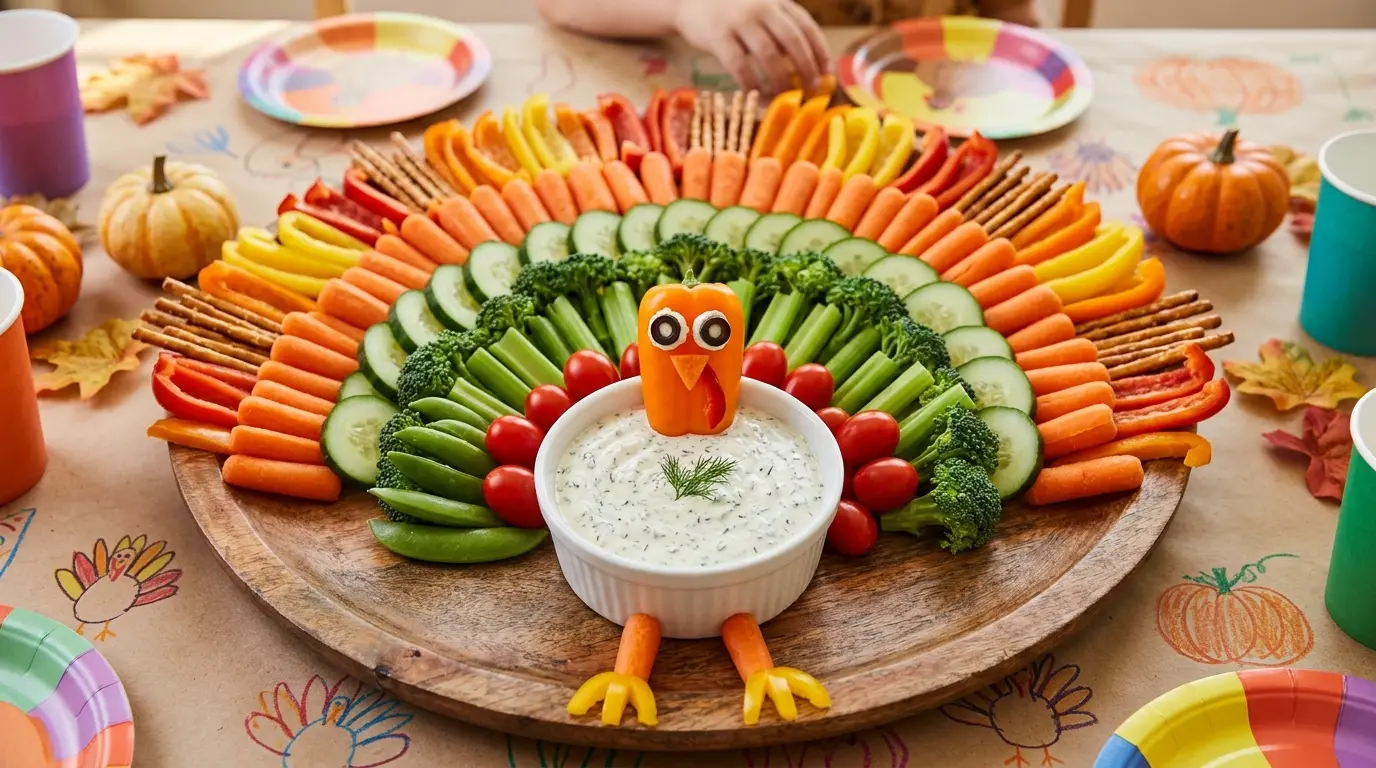
A Thanksgiving appetizer doesn’t have to be complicated to get little hands reaching for the vegetables!
A colorful turkey veggie tray is a fun way to make fresh produce more exciting while giving children something festive to enjoy before the main meal.
Whether you’re hosting Thanksgiving dinner, preparing a classroom celebration, or looking for a healthy holiday snack, these 11 easy Thanksgiving turkey veggie tray ideas for kids offer plenty of inspiration, complete with a creamy homemade herby dip that brings everything together.
Why Make a Thanksgiving Turkey Veggie Tray for Kids?
Getting children excited about vegetables can sometimes feel like negotiating a very small but surprisingly determined committee. That’s where a playful Thanksgiving turkey vegetable platter comes in.
Instead of serving carrots, cucumbers, and peppers in separate bowls, arrange them into a colorful turkey shape. The vegetables become the turkey’s feathers, body, beak, and feet, making snack time feel like part of the celebration.
A turkey veggie tray is also a practical addition to your Thanksgiving menu because it:
- Encourages healthy snacking: Children can explore different vegetables at their own pace.
- Adds festive color: Red, orange, yellow, and green vegetables create a beautiful holiday centerpiece.
- Works as a make-ahead appetizer: Most vegetables can be washed and prepared ahead of time.
- Offers plenty of choices: Children can select their favorite vegetables instead of being served a fixed portion.
- Makes Thanksgiving more interactive: Kids can help arrange the feathers, decorate the turkey, and choose their dipping vegetables.
The best part? You don’t need complicated ingredients or professional food-styling skills. A large platter, fresh vegetables, and a little creativity are enough.
You can make your Thanksgiving vegetable platter as simple or elaborate as you like. The trick is to choose vegetables with different colors, shapes, and textures so the finished turkey looks interesting and inviting.
Here are 11 creative ways to arrange your vegetables.
1. Classic Rainbow Turkey Veggie Tray
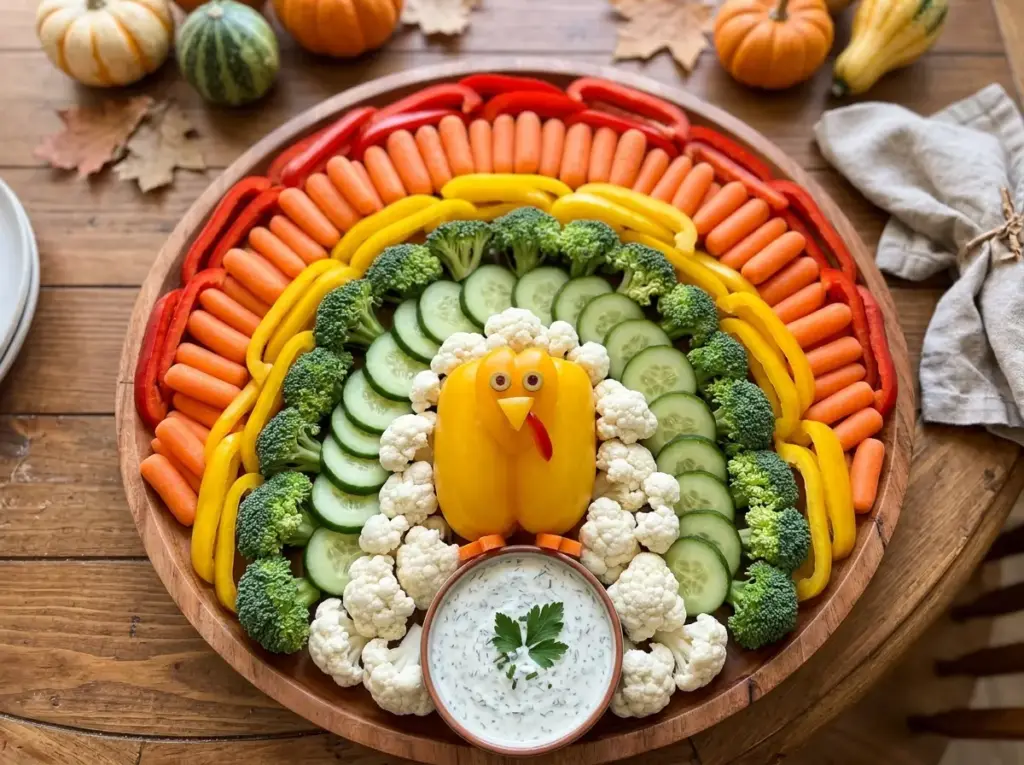
This is a lovely starting point if you want a traditional Thanksgiving turkey vegetable tray.
Arrange sliced vegetables in curved rows behind a central turkey body. Use red, orange, yellow, and green vegetables to create rainbow-like feathers.
What you’ll need:
- Red and yellow bell pepper strips
- Cucumber rounds
- Baby carrots
- Broccoli florets
- Cauliflower florets
- A small bowl of herby dip
Place a halved bell pepper or a small round vegetable near the center to create the turkey’s body. Add a small piece of red pepper for the wattle and a triangular yellow pepper piece for the beak.
Kid-friendly tip: Let children choose which vegetables go into each feather row. It gives them a little ownership of their Thanksgiving snack.
2. Mini Turkey Veggie Cups
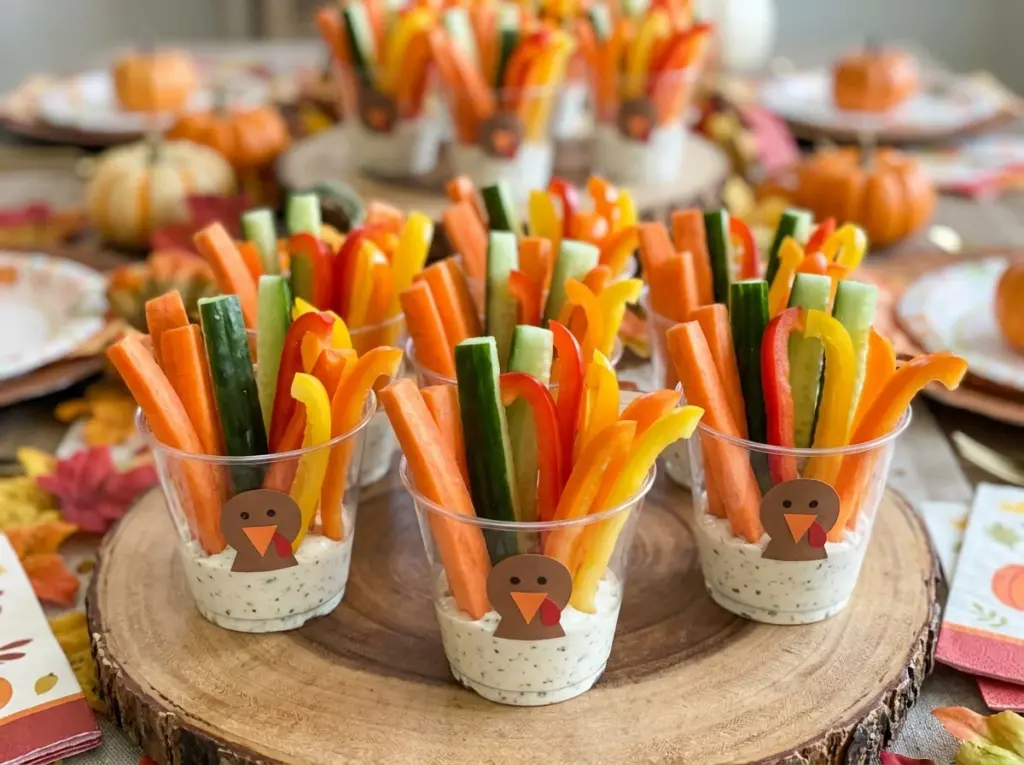
Individual veggie cups are perfect for classroom parties, children’s Thanksgiving gatherings, and buffet tables.
Fill small clear cups with a spoonful of herby dip at the bottom. Add cucumber sticks, bell pepper strips, and carrot sticks vertically so they look like colorful turkey feathers.
For a festive finishing touch, attach a paper turkey face to the outside of each cup.
Why this works: Every child gets an individual serving, which makes sharing easier and keeps the main platter less crowded.
3. Turkey Tray with Carrot and Cucumber Feathers
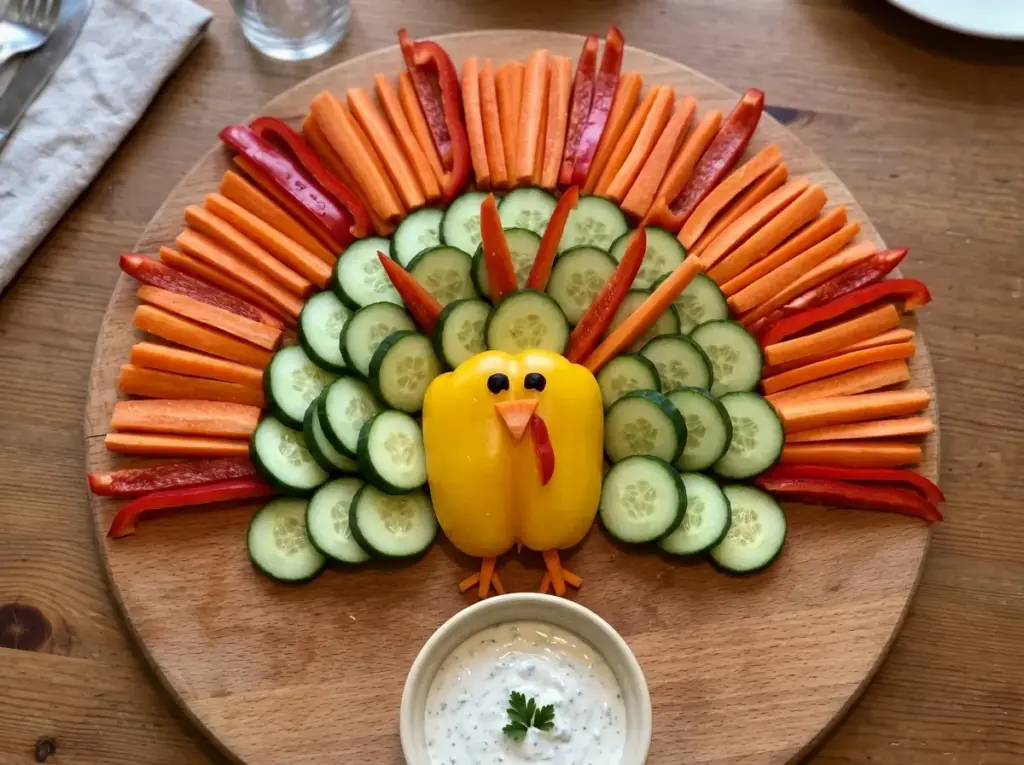
If you’re working with a limited grocery budget, this design is an excellent choice.
Use cucumber slices for the lower feathers and carrot sticks for the upper feathers. Add a few red pepper strips for contrast.
A small bowl of homemade dip can sit in the middle or just below the turkey’s body.
You don’t need ten different vegetables to create something attractive. Two or three colorful options arranged thoughtfully can look just as appealing.
4. Broccoli and Cauliflower Turkey Platter
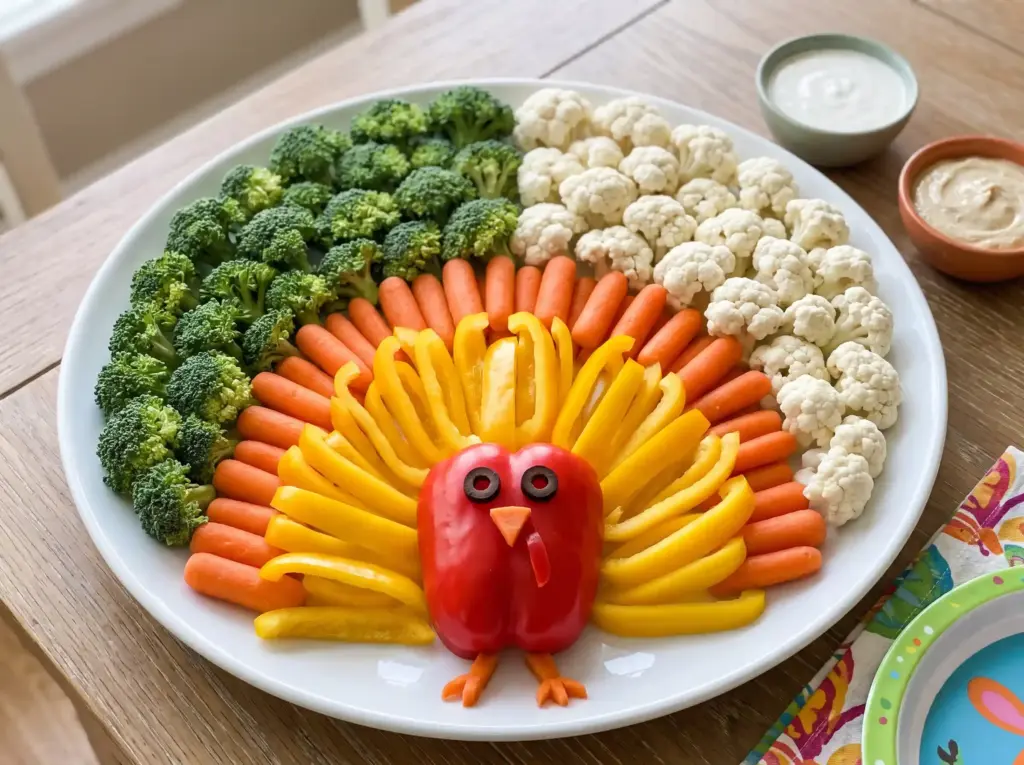
Want to introduce children to vegetables they might usually avoid? Try combining broccoli and cauliflower into the turkey’s feather design.
Arrange broccoli florets along one side and cauliflower florets along the other. Fill the remaining spaces with carrots and yellow pepper strips.
The contrasting green and white colors make the turkey stand out beautifully.
Serving suggestion: Keep the broccoli florets small and manageable, and offer softer vegetable alternatives for younger children.
5. Colorful Bell Pepper Turkey Feathers
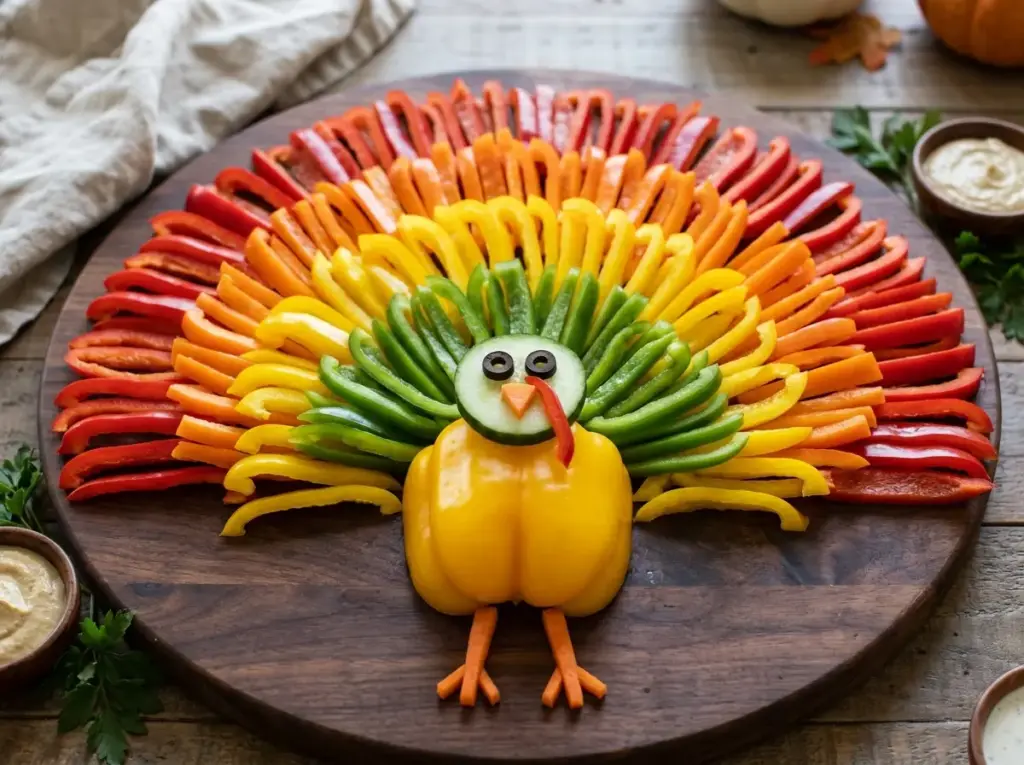
Bell peppers are particularly useful for creating a bright, eye-catching turkey platter.
Slice red, orange, yellow, and green peppers into similar-sized strips. Arrange them in a wide fan behind a central turkey body.
You can use a cucumber round for the turkey’s face, a tiny carrot triangle for the beak, and a red pepper piece for its wattle.
This is also a good option for children who enjoy crunchy vegetables and colorful food.
6. Turkey Veggie Tray with a Hummus Center
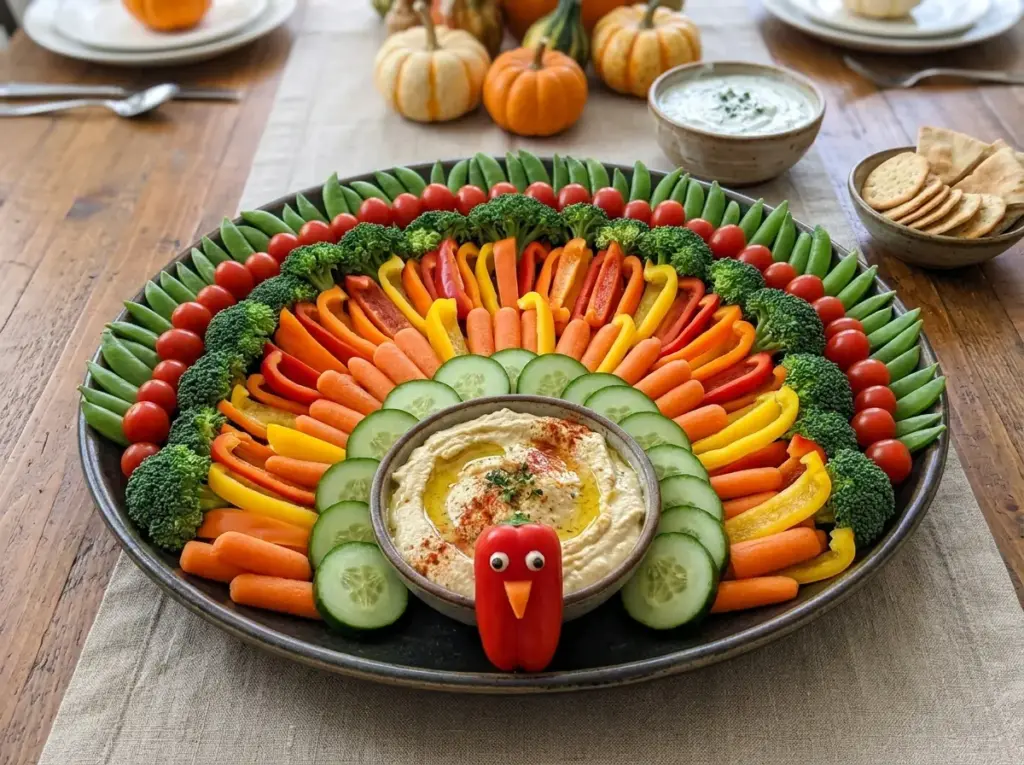
Give your Thanksgiving platter a slightly different flavor by replacing the creamy herby dip with hummus.
Place a small bowl of hummus in the center and arrange cucumber slices, carrot sticks, bell peppers, and broccoli around it.
You can even make a two-dip platter with hummus on one side and homemade herby yogurt dip on the other.
This gives guests different flavors to enjoy without requiring an entirely separate appetizer.
7. Simple Turkey Veggie Tray with Crackers
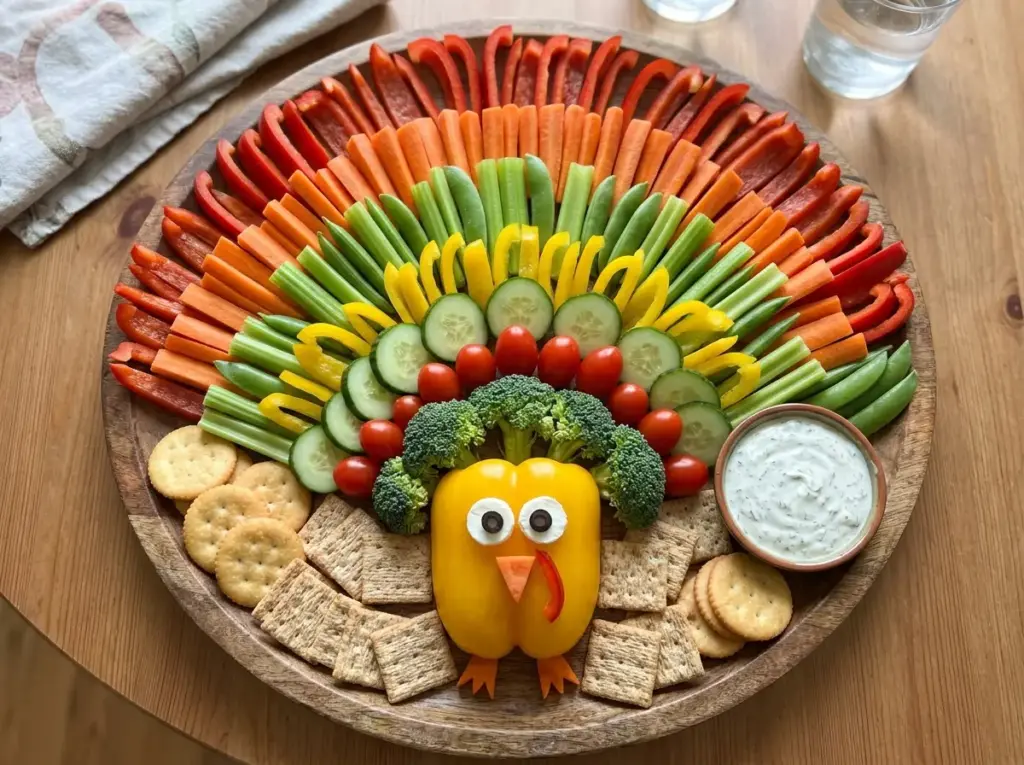
Not every child is enthusiastic about vegetables alone. Adding crackers can make the platter more appealing.
Arrange vegetable strips into turkey feathers, then fill empty spaces with small portions of crackers.
Choose plain crackers or whole-grain varieties that complement the dip without overpowering the fresh vegetables.
For a balanced platter, keep the vegetables as the main attraction and use crackers as an additional snack.
8. Turkey Veggie Platter with Edible Turkey Face
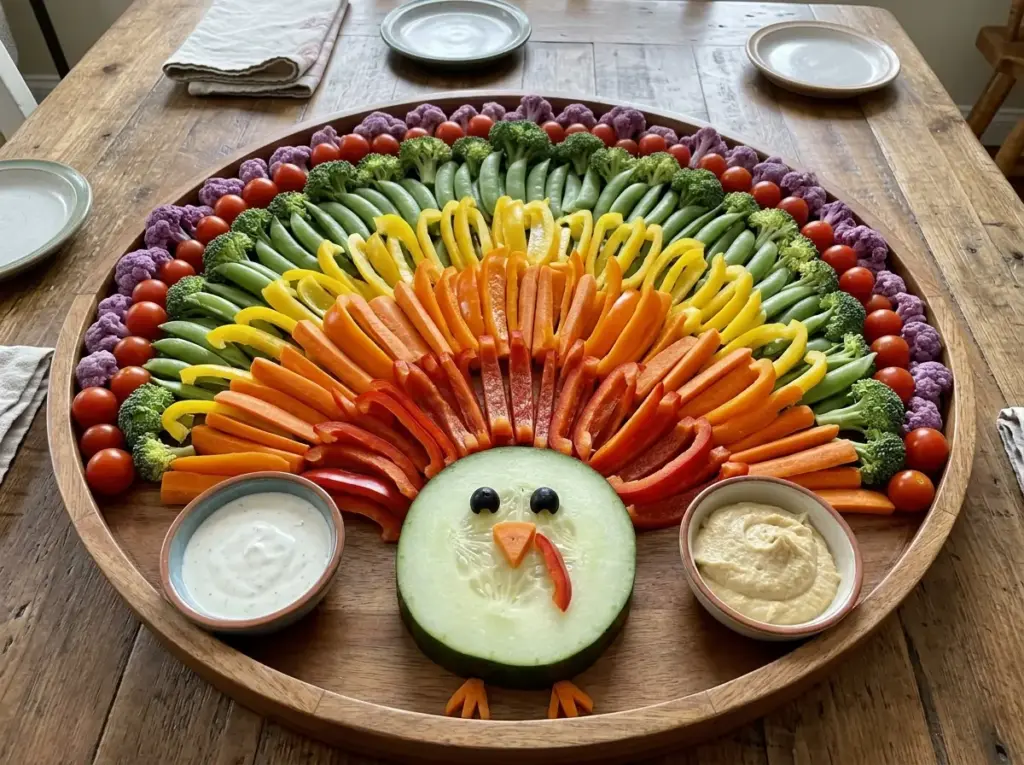
This design focuses on making the turkey’s face the star of the platter.
Use a large cucumber slice or another suitable round vegetable as the face. Add two small pieces of olive or another suitable topping for eyes, a tiny carrot triangle for the beak, and a red pepper strip for the wattle.
Arrange colorful vegetable strips behind the face to create the feathers.
Children often enjoy recognizing familiar shapes in their food, and this turkey face gives the platter a playful personality.
9. Thanksgiving Turkey Vegetable Platter with Fruit
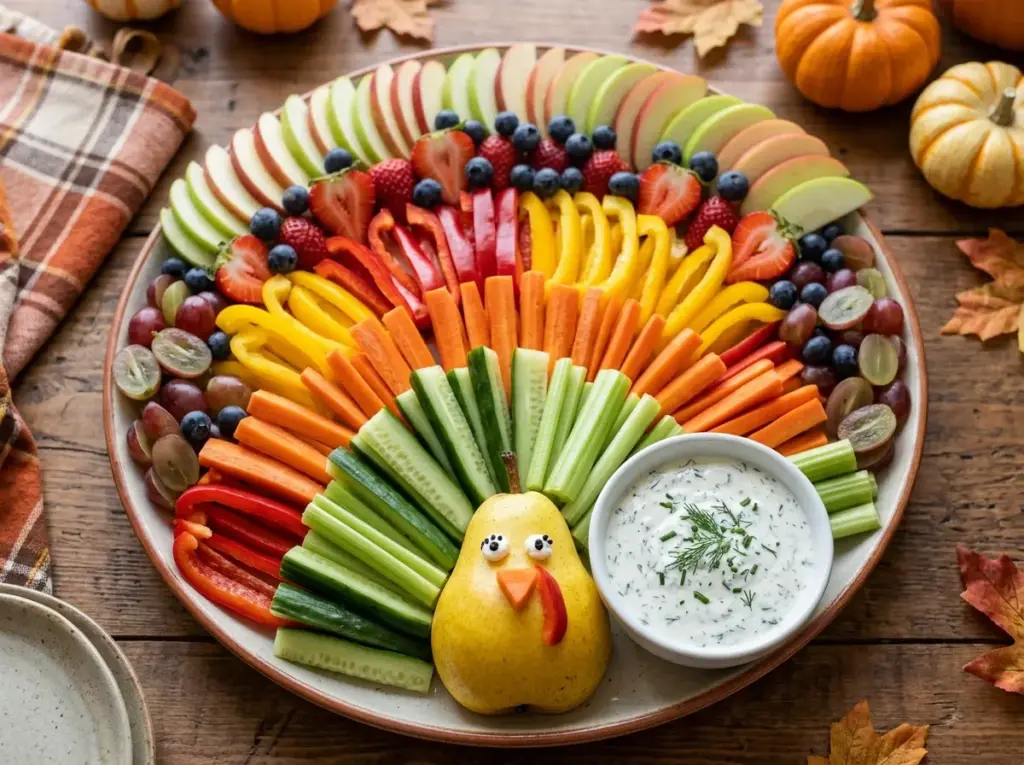
For a sweeter twist, combine fresh fruit and vegetables in one festive platter.
Use vegetable strips for the turkey feathers and add fruit around the outer edges. Strawberries, blueberries, and appropriately prepared apple slices can bring extra color.
Serve the vegetables with herby dip and keep the fruit in a separate section to avoid mixing flavors.
Important: Prepare grapes and other small round fruits in age-appropriate ways to reduce choking risks for young children.
10. Turkey Veggie Tray with Cheese Stars
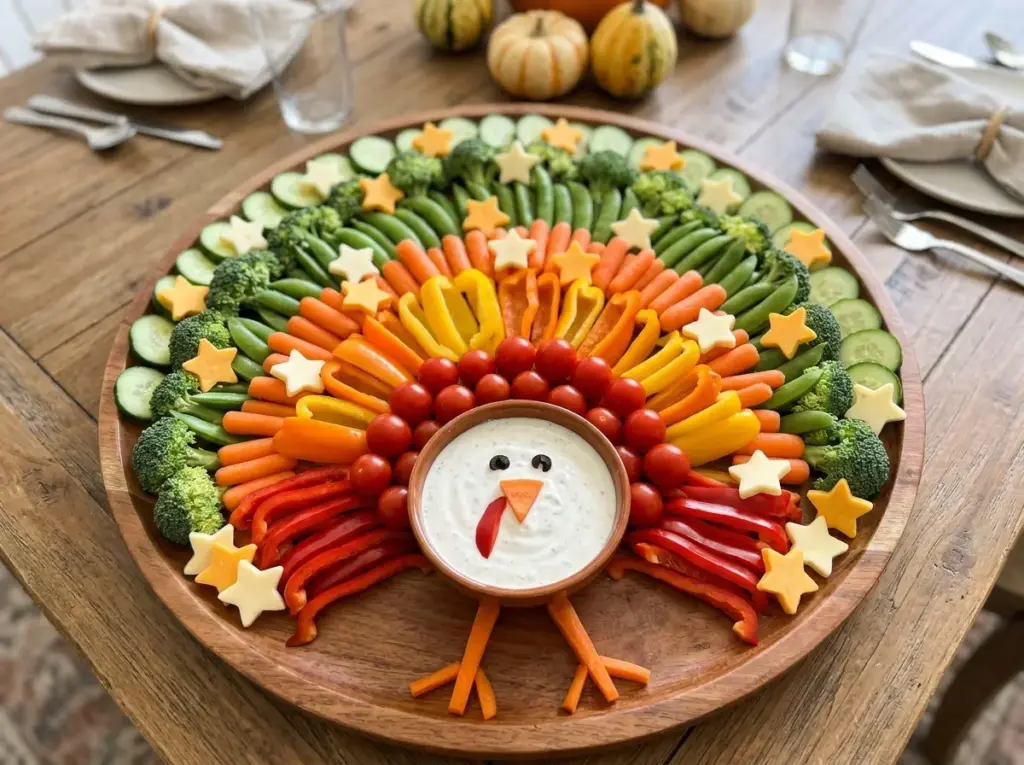
Cheese adds a fun little surprise to a vegetable platter.
Use a small star-shaped cutter to make cheese decorations, then arrange them between the vegetable feathers.
You can use mild cheddar, mozzarella, or another cheese your family enjoys.
Keep the cheese pieces small and easy to handle, and remember to refrigerate the platter until serving time.
11. Large Thanksgiving Turkey Veggie Centerpiece
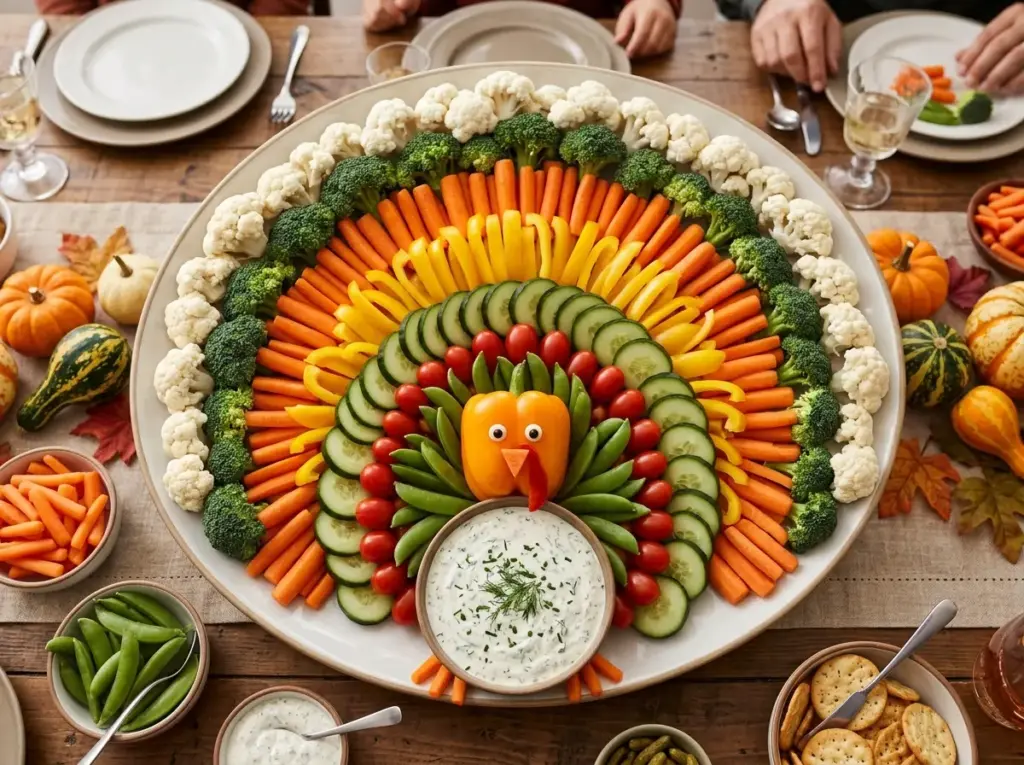
If you’re hosting a large family Thanksgiving gathering, this is the design to consider.
Use a large oval serving platter and build a generous turkey with several layers of vegetables. Combine carrots, cucumbers, broccoli, cauliflower, bell peppers, and other family favorites.
Place a bowl of homemade herby dip near the bottom of the turkey, leaving enough room for guests to reach the vegetables comfortably.
You can also prepare smaller vegetable sections around the centerpiece so children and adults can serve themselves easily.
My recommendation: Use different colors in each feather section rather than mixing everything together. It creates a more organized presentation and makes it easier for children to identify their favorite vegetables.
Homemade Herby Dip for Your Thanksgiving Turkey Veggie Tray
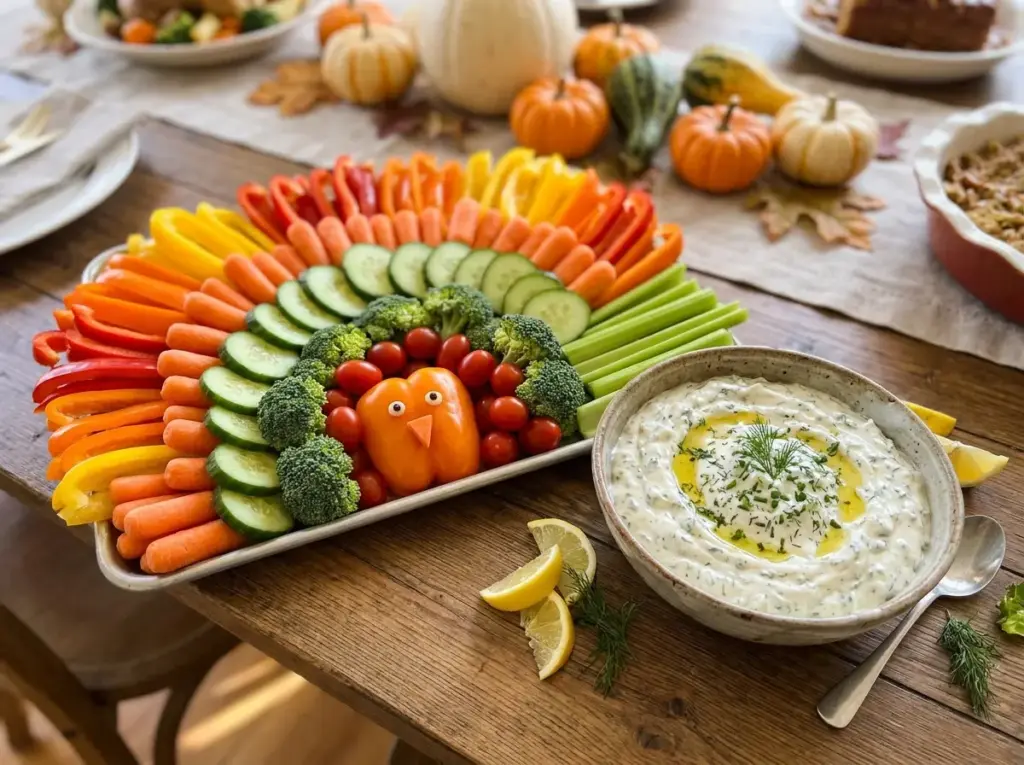
A beautiful turkey vegetable platter deserves a dip that’s just as inviting.
This homemade herby dip combines creamy yogurt and sour cream with fresh herbs, garlic, and a little lemon juice. It has a mild, refreshing flavor that pairs beautifully with crunchy vegetables.
It’s also easy to prepare ahead of your Thanksgiving gathering.
Ingredients
Preparation time: 10 minutes
Chilling time: 20–30 minutes
Total time: Approximately 40 minutes
Servings: 6–8, depending on portion size
| Ingredient | Amount |
|---|---|
| Plain Greek yogurt | ½ cup |
| Sour cream | ½ cup |
| Fresh parsley, finely chopped | 1 tablespoon |
| Fresh dill, finely chopped | 1 tablespoon |
| Fresh chives, finely chopped | 1 tablespoon |
| Garlic powder | ¼ teaspoon |
| Onion powder | ¼ teaspoon |
| Fresh lemon juice | 1 teaspoon |
| Salt | To taste |
| Black pepper | To taste |
How to Make Homemade Herby Dip
Step 1: Prepare the herbs.
Wash the parsley, dill, and chives under running water. Dry them thoroughly using a clean kitchen towel before chopping.
Step 2: Combine the creamy ingredients.
Add the Greek yogurt and sour cream to a medium-sized mixing bowl. Stir until the mixture becomes smooth and creamy.
Step 3: Add the seasonings.
Mix in the chopped herbs, garlic powder, onion powder, and lemon juice.
Step 4: Adjust the flavor.
Add a little salt and black pepper. Taste the mixture and adjust the seasoning according to your preference.
If the dip is too thick, add a small spoonful of yogurt. If you prefer a stronger herbal flavor, add a little more dill or parsley.
Step 5: Refrigerate before serving.
Cover the bowl and refrigerate for approximately 20–30 minutes. This gives the herbs time to flavor the creamy base.
Step 6: Serve with your turkey veggie tray.
Transfer the dip into a small serving bowl and place it near the turkey’s body or at the bottom of the vegetable platter.
For a decorative touch, sprinkle a little chopped parsley on top.
Easy Herby Dip Variations
You can adjust the recipe to suit different preferences.
- Garlic herb dip: Add a little extra garlic powder for a stronger savory flavor.
- Lemon dill dip: Increase the dill and lemon juice for a fresher taste.
- Avocado herb dip: Mash a ripe avocado into the yogurt mixture for a thicker, richer dip.
- Dairy-free dip: Use an unsweetened, plain dairy-free yogurt alternative and check its consistency before serving.
- Milder children’s dip: Reduce the garlic and onion seasoning for children who prefer gentler flavors.
How to Assemble a Thanksgiving Turkey Veggie Tray Step by Step
Once you’ve chosen your favorite design and prepared the dip, putting everything together is surprisingly simple.
What You’ll Need
- One large oval or round serving platter
- A small bowl for the herby dip
- A sharp kitchen knife
- A vegetable peeler
- A chopping board
- Small cookie cutters (optional)
- Fresh vegetables of your choice
Step 1: Wash and Prepare the Vegetables
Choose vegetables with a variety of colors and textures. Wash them thoroughly under running water before cutting.
Cut carrots into sticks, cucumbers into rounds, and bell peppers into strips. Separate broccoli and cauliflower into small florets.
Pat the vegetables dry before arranging them. Excess moisture can make the platter look messy and cause the dip to become watery.
Step 2: Create the Turkey’s Body
Place a small bowl of herby dip near the bottom center of your platter.
You can arrange a large cucumber slice or a suitable round vegetable above the bowl to represent the turkey’s head and body.
Alternatively, use a small bowl as the turkey’s body and decorate its front with a simple vegetable face.
Step 3: Arrange the Colorful Feathers
Start arranging your vegetables behind the turkey’s body in curved rows.
A simple color sequence could be:
- Red bell peppers
- Orange carrots
- Yellow bell peppers
- Green cucumbers
- Broccoli florets
Don’t worry about making every piece perfectly symmetrical. A little variation gives the platter a natural, homemade appearance.
Step 4: Add the Turkey’s Face
Use small vegetable pieces to create the eyes, beak, and wattle.
- Eyes: Small pieces of suitable olives or cucumber.
- Beak: A tiny carrot triangle.
- Wattle: A small piece of red bell pepper.
Make sure all decorative pieces are securely arranged and appropriate for the children’s ages.
Step 5: Fill Empty Spaces
Look for gaps between the vegetable feathers. Fill them with smaller pieces of cucumber, carrots, or broccoli.
Avoid overcrowding the platter. Children should be able to pick up vegetables without disturbing the entire arrangement.
Step 6: Add the Homemade Herby Dip
Place the chilled dip in a small bowl on the platter or beside it.
For larger gatherings, serve additional dip in a separate bowl so guests don’t have to crowd around one serving area.
Your Thanksgiving turkey veggie tray is ready!
7 Essential Vegetables and Extras for a Colorful Turkey Platter
You don’t need an expensive shopping list to make a beautiful Thanksgiving vegetable centerpiece. A handful of affordable ingredients can create plenty of color and variety.
| Ingredient | Best use |
|---|---|
| Carrots | Orange turkey feathers |
| Cucumbers | Green feathers and turkey face |
| Red bell peppers | Bright red feathers and wattle |
| Yellow bell peppers | Yellow feathers and beak |
| Broccoli | Green feather sections |
| Cauliflower | White feather sections |
| Cherry tomatoes | Decorative color accents |
You can also include cheese, crackers, hummus, or fruit if you want a more substantial appetizer.
Budget-saving tip: Buy vegetables that can serve multiple purposes. For example, one cucumber can provide turkey feathers, facial decorations, and dipping sticks.
5 Helpful Tips for Making a Kid-Friendly Thanksgiving Veggie Tray
A turkey-shaped platter should look attractive, but it also needs to be practical for children.
Here are a few ways to make yours more enjoyable.
1. Choose Vegetables Children Already Enjoy
It’s tempting to fill the platter with every vegetable available, but familiar favorites are a good starting point.
If your children enjoy carrots and cucumbers, use more of those and introduce one or two unfamiliar vegetables.
2. Make the Vegetables Easy to Pick Up
Long carrot sticks, cucumber rounds, and manageable pepper strips are convenient for older children.
For younger children, prepare vegetables according to their developmental stage and chewing ability.
3. Keep the Colors Balanced
A combination of red, orange, yellow, green, and white vegetables creates a more attractive platter.
Try not to place all the green vegetables in one crowded section.
4. Let Children Help Decorate
Give older children simple jobs such as arranging the feathers, choosing vegetable colors, or sprinkling chopped herbs over the dip.
Younger children can help select vegetables with adult supervision.
5. Make the Dip Easy to Reach
Place the dip in a shallow, stable bowl. This makes dipping easier and reduces the likelihood of accidental spills.
If you’re serving a large group, provide individual dipping portions or separate serving bowls.
How to Prepare Your Turkey Veggie Tray Ahead of Thanksgiving
Thanksgiving can involve plenty of kitchen activity, so preparing some ingredients beforehand makes a difference.
Here’s a simple preparation schedule.
| When | What to do |
|---|---|
| 1–2 days before | Buy vegetables and prepare the homemade herby dip |
| The day before | Wash, dry, and cut suitable vegetables; refrigerate in covered containers |
| Thanksgiving morning | Arrange the turkey body and vegetable feathers |
| Just before serving | Add the chilled dip and final decorations |
Keep the dip refrigerated until serving. Avoid leaving the finished platter at room temperature for extended periods.
If you’re preparing vegetables in advance, store them in clean, covered containers in the refrigerator. Add delicate decorations shortly before serving to maintain their appearance.
Food Safety Tips for Serving Fresh Vegetables to Children
A colorful appetizer is wonderful, but food safety deserves just as much attention as presentation.
Here are some important precautions:
- Wash fresh vegetables under running water before cutting or eating them.
- Use clean utensils, chopping boards, and serving dishes.
- Keep fresh produce separate from raw meat and poultry.
- Refrigerate cut vegetables and dairy-based dips promptly.
- Don’t leave perishable foods at room temperature for more than two hours, or one hour when temperatures exceed 90°F (32°C).
- Keep children supervised while eating.
For young children, some raw vegetables require special preparation. Hard raw carrot pieces, whole cherry tomatoes, and other firm or round foods can present choking risks. Cook or soften hard vegetables when appropriate, and cut foods into age-appropriate shapes and sizes.
The CDC provides additional guidance on choking hazards for infants and toddlers. For produce handling, see the CDC’s fruit and vegetable safety guidance. CDC+2
Frequently Asked Questions
1. What vegetables are best for a Thanksgiving turkey veggie tray?
Carrots, cucumbers, red and yellow bell peppers, broccoli, and cauliflower are excellent choices. They offer different colors and textures, making it easier to create attractive turkey feathers.
You can also include celery, zucchini, and other vegetables your family enjoys.
2. Can I make a turkey veggie tray the night before Thanksgiving?
Yes. You can wash and cut most vegetables the day before and store them in separate covered containers in the refrigerator.
For the best presentation, assemble the turkey shortly before serving. Keep the dip chilled separately until you’re ready to set out the platter.
3. How do I keep cut vegetables fresh overnight?
After washing and preparing your vegetables, dry them thoroughly and place them in clean, covered containers in the refrigerator.
Some vegetables benefit from a slightly damp paper towel, while others stay crisper when stored dry. Keep the vegetables separate when possible to preserve their individual textures.
4. What can I use instead of sour cream in homemade herby dip?
Plain Greek yogurt is a convenient alternative. You can also use an unsweetened dairy-free yogurt alternative if you need a dairy-free option.
The texture and flavor may vary depending on the substitute.
5. How long does homemade herby dip last?
For this recipe, keep the dip covered in the refrigerator and use it within approximately 3–4 days, provided it has been handled and stored safely.
Always use a clean serving spoon and avoid returning leftover dip from a used serving bowl to the storage container. Nebraska+1
6. How do I make a turkey veggie tray without using a special platter?
A regular dinner plate, baking tray, wooden serving board, or large oval dish works perfectly.
Arrange the vegetables in a fan shape and use a small bowl for the turkey’s body or dip. You don’t need special Thanksgiving serving equipment.
7. What can I serve with a turkey veggie tray?
You can serve it alongside cheese cubes, crackers, hummus, fruit, mini sandwiches, or other Thanksgiving appetizers.
For a children’s gathering, keep the vegetable platter as the main attraction and offer a few familiar extras.
8. How do I make a turkey veggie tray appealing to picky eaters?
Start with vegetables your children already like. Arrange them in familiar colors and shapes, and serve a mild dip alongside them.
Let children choose their own portions rather than insisting they try everything. Sometimes making food playful is enough to encourage a little curiosity.
Conclusion: Make Thanksgiving Snacking Colorful and Fun
These 11 easy Thanksgiving turkey veggie tray ideas for kids with homemade herby dip show that a festive appetizer doesn’t need complicated ingredients or hours of preparation.
From a simple carrot-and-cucumber turkey to a large rainbow vegetable centerpiece, there’s an arrangement for every family gathering and budget.
Choose vegetables your children enjoy, prepare a creamy dip, and let the little ones help decorate the turkey. It’s a simple way to add color, creativity, and a little extra fun to your Thanksgiving table.
After all, Thanksgiving memories aren’t made only around the main meal. Sometimes, the little turkey-shaped appetizer on the table gets just as much attention!